Five best HR software platforms for medium-sized businesses


Mid-sized businesses often struggle to find the right HR software to fit their evolving needs without locking them into complex tech better suited to enterprises. While these companies have outgrown spreadsheets and informal processes, they still need a better way to handle a heavier administrative load.
The best HR software for medium-sized businesses helps teams create repeatable people practices that evolve with their headcount. It adds a level of structure to support lean HR teams in building workflow consistency and data cohesion instead of burdening them with yet another tool to manage.
Keep reading to learn the best HR software solutions for mid-sized companies, including key features, benefits, and use cases for managing your growing operational overhead.
What features should HR software for medium-sized businesses include?
“Look for one platform that covers your key needs and integrates with your stack. Don’t scatter data across 10 or 20 disconnected tools.”
— Katerina Arsova, Head of People & Talent Operations & Partnerships, Leapsome
It’s easy to head straight to the feature lists for HR software when you’re comparing platforms. But medium-sized businesses should focus on how a platform can help solve growth-related problems instead of the number of bells and whistles it offers.
During intense growth periods, management complexity tends to impact diverse HR functions:
- Core HR and automation: Keeping up employee data across systems can become unsustainable with a larger headcount. HR teams require synced records, workflows, and self-service portals to cut out duplicate data entry and repeated employee questions.
- Performance and employee development: Letting managers handle reviews and performance ad-hoc leads to inconsistent decision-making. HR software helps add structure to reviews and goals, so that criteria remains well-documented and feedback stays productive for employee development.
- Analytics and integrations: Data-backed strategies are difficult to enact without strong underlying reporting. The best HRIS software solutions connect data across the tech stack and enable configurable reports to improve people insights.
Work closely with your stakeholders and managers to identify top priorities and pain points. Otherwise you risk investing in a sophisticated platform that doesn’t meet your requirements and frustrates your employees.
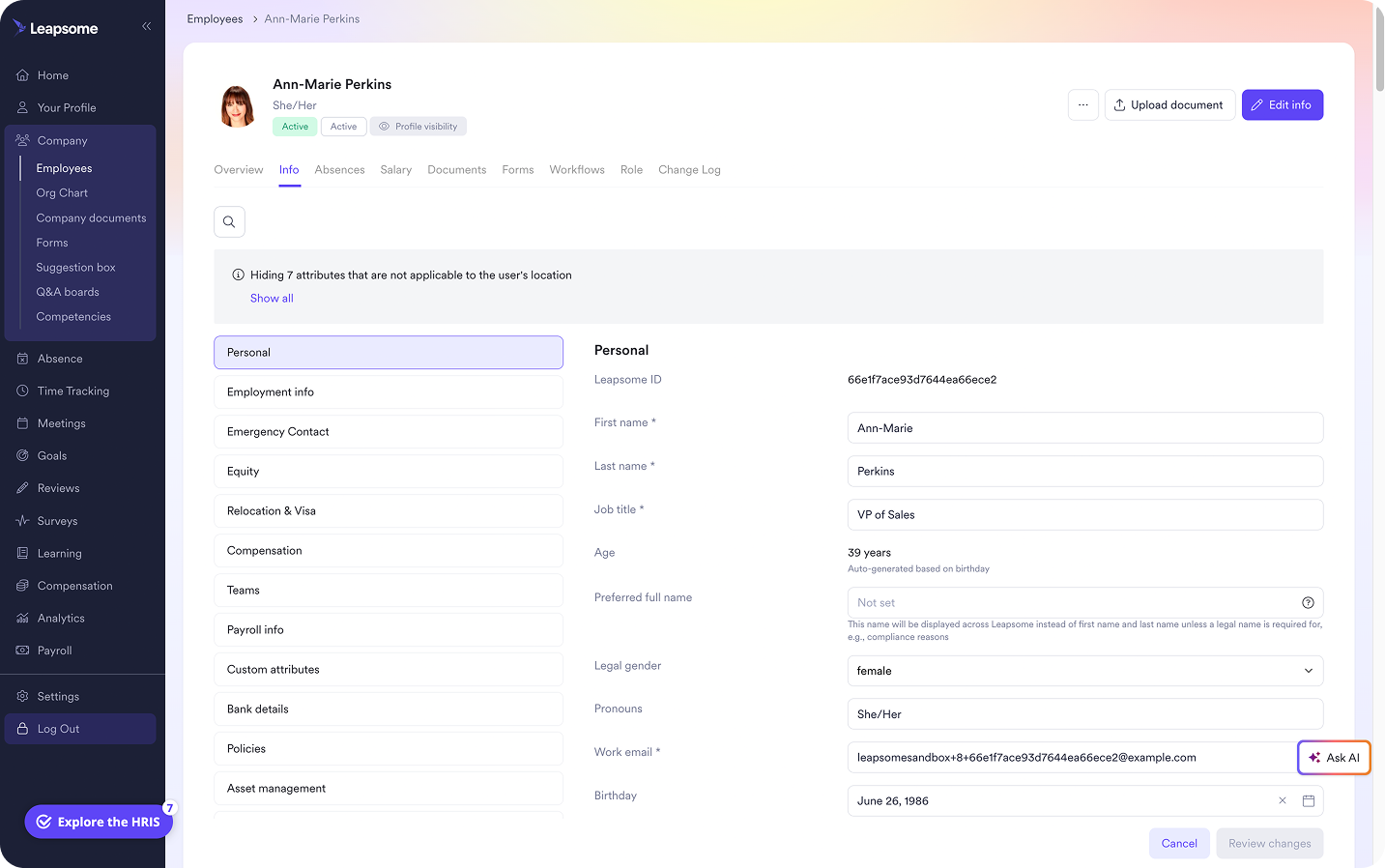
🔁 Get clearer downstream analytics
Leapsome sets up a strong HR data foundation for your business, so you can connect employee records to data-driven compliance. Pull reports or analyze trends by drawing directly from real-time records.
👉 Explore Employee Records
Key strengths of HR software for medium-sized businesses
“It’s one big lift to automate, but every cycle after that becomes faster and easier. Automating the invisible work gives HR leaders back time for culture, strategy, and meaningful connection.” — Emma Leeds, Founder, CEO & Chief People Consultant, People Function
As they scale, medium-sized businesses can no longer rely on informal workflows. A higher headcount means not only more people to manage but also more paperwork to process and careers to support. The best HR software lightens this load by:
- Creating more consistent people practices: Managers can use shared criteria built into the HR software to set goals and give feedback, reducing inconsistency and bias in reviews.
- Reducing the administrative workload: HR teams can automate routine processes, such as standard requests or onboarding workflows. This lets them cut out manual reminders, routing, and documentation.
- Improving people-data visibility: Leadership can get stronger insights by unifying workforce data for engagement, performance, retention, and growth. As a result, HR can more easily pull reports and identify trends that support key people decisions.
Five best HR software for mid-size companies
“Individuals can’t muscle a 500-person org through chaos. Build the systems so good responses are easy, natural, and repeatable, especially when stress is high.”
— Craig Forman, Founder & Principal Consultant, CultureC Consulting
Every mid-sized company has their own set of priorities to determine what HR software is right for them. The right choice depends considerably on where HR needs the most support and how existing systems hold up with increased operational complexity.
1. Leapsome
Leapsome combines operational HR and deeper people practices into a unified HR management platform. It’s an optimal choice for growing businesses due to its capabilities to set up custom workflow automation and sync with employee records at every stage.
In addition to its core HR suite, Leapsome has excellent tooling to support managers in giving feedback and developing employee skills. Robust people-focused features include Reviews, Goals & OKRs, Engagement Surveys, Competencies, Instant Feedback, and 1:1 meeting support.
While Leapsome has a wide breadth of features for mid-sized business, configuration can take time (and training) for successful adoption.
2. BambooHR
BambooHR is a comprehensive HR platform with a reputation for ease of use. It supports lean HR teams by centralizing data, onboarding flows, and employee self-service into one place. It also hosts a reliable mobile app for on-the-go HR and employee tasks.
Compared to other tools, BambooHR’s performance features and analytics can feel lightweight, but it’s a good starting point for handling core HRIS needs — especially for companies without a dedicated HR department.
3. HiBob
HiBob is a culture-focused HR management platform that’s great for global mid-sized businesses. Its interface is community-led, with native features for performance reviews, engagement surveys, and goals. Customization is available for specific countries, which is ideal for distributed teams with unique data or legal requirements.
Although HiBob has other essential functionality (such as onboarding, payroll, and applicant tracking), it doesn’t have the advanced reporting or customization that some mid-sized companies may need as they grow.
4. Rippling
Rippling brings together HR, IT, and finance into a single management platform. It’s best for remote mid-sized teams who need to easily track attendance, device usage, and HR compliance across locations. It also helps HR sync employee data directly with payroll and benefits administration.
Rippling has some unique features that aren’t available on other HR software platforms (such as device management), but these capabilities also come with more complex set-up. Your HR team may need a dedicated IT member to help manage these more sophisticated features.
5. Personio
Personio is a Europe-based HR solution that covers core HR tasks, including applicant tracking, onboarding, performance management, and payroll.
It’s a strong choice for mid-sized businesses in Europe that want to centralize records and ensure EU compliance. Its onboarding flows are especially polished, though it has fewer feedback and learning tools to support career development.
The mid-size HR complexity test: What starts breaking as you grow
“The horror stories are outdated. For a 100 to 200-person company, go-live in a couple of months is realistic — [and it’s] even faster with a clear scope. Don’t let an old myth keep you from the system you need.”
— Florian Klages, Managing Partner, torq.partners
Medium-sized businesses face unique challenges as they outgrow their informal HR systems. Ad-hoc processes that once worked well can no longer handle the increased management complexity that comes with a higher headcount.
As your company builds up your teams or adds people programs, you may require more reliable HR structures to keep up. Growing companies often identify the need for new software when:
- HR bandwidth stretches thin: Lean HR teams may start to feel overwhelmed as they manually handle higher volumes of employee questions, approval routing, and data entry.
- Manager inconsistency impacts employee experiences: Without standard performance criteria and goal setting, every manager does things their own way. As a result, employees may face bias in reviews and uneven experiences across teams.
- Visibility into people data depends on manual reconciliation: Fragmented sources means HR has to manually pull and cross-reference data to get accurate insights into people analytics for retention, engagement, performance, and workforce trends.
If you’re struggling with any of these problems, you may have outgrown your current tech stack. Just be wary of any HR solutions that are more complex than you need.
According to a report from Deloitte, only 50%–75% of organizations report getting real value out of their major tech investments. Find a platform that addresses your company’s specific priorities instead of reaching for the shiniest solution.
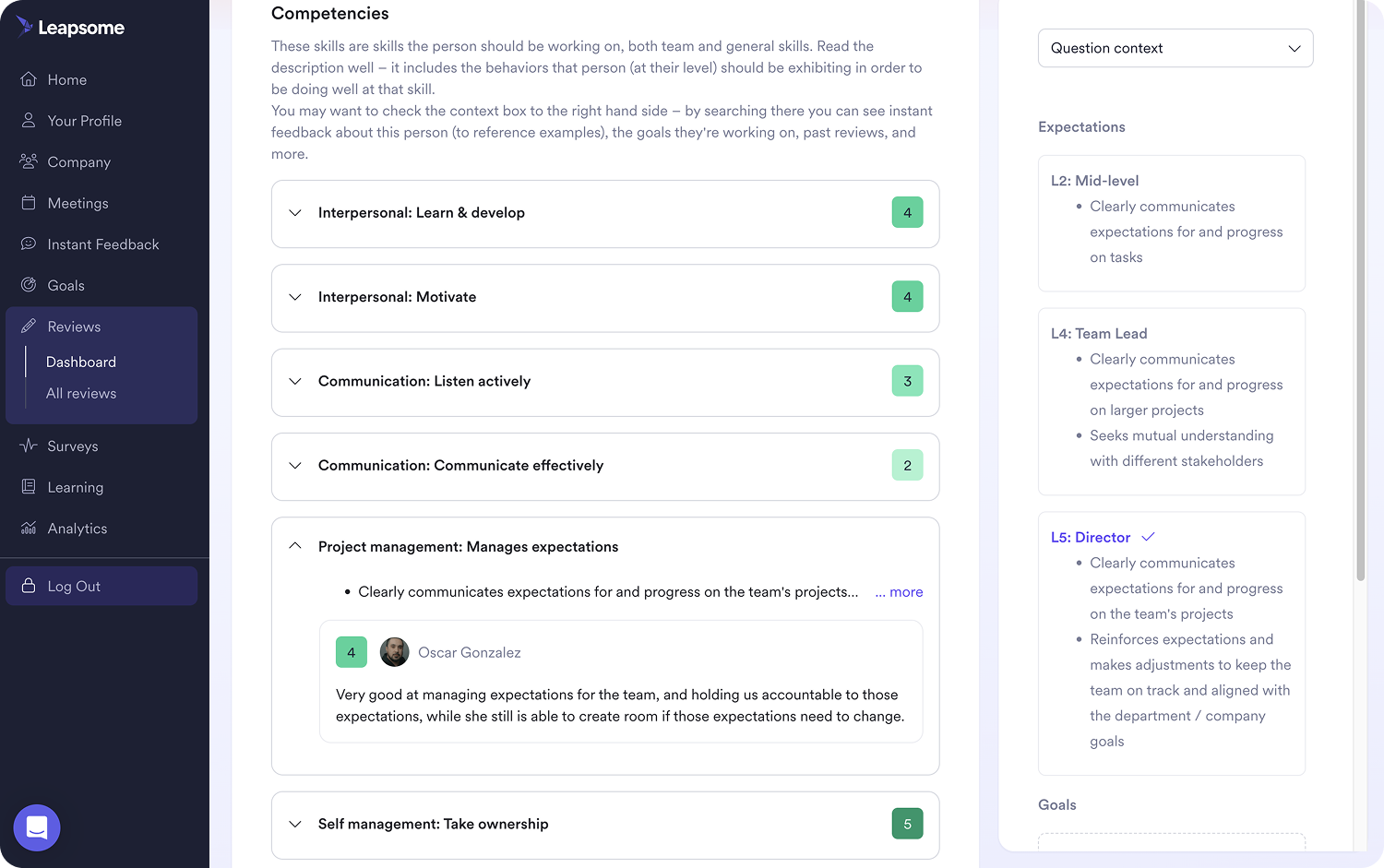
💡 Run smarter performance reviews
Leapsome brings consistency and meaning to performance reviews. By drawing on in-platforms goals, competencies, engagement insights, and ongoing feedback, managers can give employee development the full attention and monitoring it deserves.
👉 Discover Performance Reviews
Build stronger HR foundations as your medium-sized business grows with Leapsome
“Start with a clear why. Do forward-looking economics. Show what growth will cost you without the right system.” — Siddharth Dhanuka, Head of Finance & Operations, SQUAKE
As your business grows, your HR team may face increased administrative complexity, as well as greater expectations from leadership to focus on strategy. HR may be tasked with supporting managers in running better reviews, employees in developing stronger goals, and leadership in gleaning useful people insights.
Leapsome can help your organization add structure to handle a higher headcount while avoiding introducing unnecessary complexity. It’s designed to deepen people practices and simplify operational HR.
- Get a built-in operational foundation: Leapsome provides a core HR suite that includes everything from unified Employee Records and Pre & Onboarding to integrated Time Tracking and Absence Management.
- Make your management practices uniform: Leapsome uplifts managerial oversight with a wealth of native performance and learning features that enable consistent, career-driven feedback (including Reviews, Goals & OKRs, Engagement Surveys, Competencies, Instant Feedback, and 1:1 meetings).
- Drive your workflows with AI efficiency: Leapsome weaves AI Agents into its platform capabilities. For growing business, it can generate summaries, action plans, competency frameworks, and workflows directly in-platform.
- Sync up your employee records: Organizations can connect employee data at every stage in the lifecycle and see it reflected in real-time reports. For example, employee information collected in Leapsome during onboarding supports learning and development later.
Ultimately, Leapsome hits the mark for growing businesses who are looking to build custom, consistent structures for their people practices to thrive.
“There is no more fighting with the review process for managers, and the administrative work for HR is reduced by about 90%. It makes all our lives that much easier and the entire review process more transparent, efficient and valuable.” — Amanda Heeg, Senior HR Manager, Juniqe
🤝 Create people practices that scale
Set up strong people practices without the friction of enterprise complexity. Leapsome rolls your data, managerial oversight, goal-setting, and analytics into one scalable interface.
👉 Request a demo
FAQ
What is the best HR software for a small company?
Top-rated HR software for small businesses incorporates comprehensive features with easy-to-learn interfaces and affordable pricing. Popular HR tools that fit the bill include BambooHR, Zoho People, and Personio.
What is the best HR software for payroll?
For small businesses, Gusto Payroll, Paychex Flex, and JustWorks are lean but effective choices for payroll processing and tax filing. Other HR payroll software solutions designed to scale with growing businesses include Rippling, One HR, and ADP Workforce.