How to improve employee productivity: HR and managers’ guide


HR managers often get stuck between a rock and a hard place. On the one hand, the pressure to boost productivity can be intense. But on the other, no one really wants to launch an invasive employee surveillance program or set unrealistic expectations that erode work-life balance.
Uncomfortably close monitoring, grueling hours, and an ever-expanding list of tools don’t usually work. Thankfully, nurturing sustainable productivity may not be as hard as it sounds. Managers need to master the levers that drive productivity: setting clear goals, giving meaningful feedback, and supporting employee development.
Many organizations struggle with management teams that don’t have these levers down. Between 2024 and 2025, global manager engagement dropped from 27% to 22%. Workforce-wide, low engagement cost the global economy an estimated $10 trillion in lost productivity in 2025 — that’s 9% of global GDP.*
This guide helps HR and people managers avoid plummeting engagement and the low productivity that comes with it. Teams will learn how to improve employee productivity by focusing on strong core elements rather than outdated myths that do more harm than good.
* Gallup, 2026
Cascading goals for long-term alignment and transparency
Working out how to improve team productivity starts with knowing what you’re trying to achieve. An unfocused framework or a manager-by-manager jumble of competing systems usually doesn’t lead to firm results.
A well-structured goal-setting system has at least these three primary elements:
- Team goals that cascade from company-wide objectives: Organizations should break top-level goals down into smaller, shorter-term ones that cascade down to the team level.
- Individual goals that cascade from team goals: Managers should involve employees in defining goals based on team-level objectives.
- A regular review cadence: Setting a regular cadence (like monthly or quarterly) for reviewing and fine-tuning goals helps keep them relevant and focused.
Ensuring these key factors are in place keeps people aligned at every level. Instead of teams working in isolation, everyone moves in the same collaborative direction toward the same company-wide objectives. Without a cascading top-down process, it’s easy for people (or entire departments) to end up working in silos, sometimes even on contradictory goals.
Without cascading goals, organizational objectives are opaque. Transparency falls by the wayside when top-level goals aren’t clear and don’t inform objectives at lower levels. Employees aren’t sure what the ultimate aim of their efforts is, which can hurt morale and take performance down with it.
“Busy doesn’t mean effective. True productivity starts with clarity on what success looks like and why it matters.”
— Priscila Bala, CEO, LifeLabs Learning
Building a cascading goal-setting process is harder than it needs to be when objectives are spread across multiple spreadsheets and tools. Without a unified system, getting everyone on the same page can turn into a full-time job itself. Teams need a way to gather everything in one place so goals at every tier are visible and connected — and that’s where Leapsome can help.
🤝 Build alignment right into your goal-setting framework
Centralize individual, team, and company goals so aligning objectives with actual business priorities is a matter of course, not a quarterly scramble.
👉 Explore Goals & OKRs
What’s really behind productivity and how to coach to it
Well-meaning HR teams often fall prey to a few common “productivity” tactics that reputable research shows are actually unproductive. Understanding them can help organizations focus on what really works while sidestepping outdated ideas that may make things worse.
The smoke and mirrors that hurt productivity
Here’s a look at some widely used methods of boosting workplace productivity that just aren’t supported by the science.
Implementing monitoring software
Keeping a closer eye on what employees are doing can feel like a good way to keep them on-task. But does employee monitoring software actually improve productivity? The answer is often no, according to the American Psychological Association’s 2023 Work in America survey.
This research found that 32% of employees who know their work is monitored report poor or fair mental health, compared to 24% of employees who aren’t monitored. What’s more, 56% of employees who report being monitored at work say they usually feel tense or stressed during workdays, as opposed to just 40% of employees who aren’t monitored. Neither outcome is likely to nurture a productive workforce putting out good work.
Sometimes, the move is to trust employees with more autonomy, not less. A peer-reviewed paper published in the scientific journal Frontiers in Psychology found evidence that priming employees to feel a greater sense of autonomy improved their productivity by 5.2% and their mood by 31%.
Setting stricter attendance policies
When worker productivity feels stagnant or declining, some teams are tempted to rein in flexible work policies to keep employees close by. However, a December 2024 Gartner survey found that on-site and hybrid employees were equally likely to be ranked highly productive. What matters isn’t where employees work from, but fostering a supportive team culture. Organizations that succeeded here saw productivity increase by 11% for both work arrangements.
Instead of instituting a rigid policy employees might balk at, consider creating a workspace that supports mental health and psychological safety. A 2023 review of the scientific literature on this subject found significant empirical evidence that a psychologically safe work environment is “a vital ingredient for overcoming obstacles to teamwork and unleashing potential in individuals and organizations.” It can also keep burnout and turnover in check, as research by Harvard Business School’s Amy Edmondson points out.
“The foundation of great management is relationship-building. You can have all the tools, but without connection, communication, and safety, performance will always suffer.”
— Anja Schauer, Global Head of Customer Success, Leapsome
Buying more software
It’s a natural instinct to wonder whether stalled productivity is a result of employees simply not having the right tools. In many cases, the truth is that employees already have too many. A study published in Harvard Business Impact discovered that workers toggle between apps and websites about 1,200 times per day. That toggling added up to almost four extra hours worked per week.
What actually works is the opposite approach: cutting unnecessary tools until you’re left with the essentials, and ensuring they’re closely connected for easy data sharing and minimized manual work. That means less time bouncing between tools and hunting down scattered data, and more time achieving goals.
1:1s should be coaching moments, not status updates
“Caring isn’t just about being kind. It’s about helping people grow through honest feedback. Managers need to pair compassion with candor, grounding hard conversations in shared goals.”
— Luck Dookchitra, VP of People, Leapsome
Increase productivity by training managers to go deeper with revealing questions and meaningful, constructive feedback in 1:1 meetings. Truly good managers know how to give feedback that stokes motivation and engagement instead of leaving employees demoralized or unsure what to do next. After all, 80% of employees who reported receiving meaningful feedback in the past week were fully engaged, according to Gallup research.
Make continuous, real-time feedback the norm
Meetings matter, but proactively offering employees feedback in the moment is just as important. The longer the gap between employee action and manager feedback, the more time the employee has to forget what their manager is referring to, making it more difficult to put two and two together.
The smartest way to avoid this pitfall is to give structure to your feedback process with Leapsome.
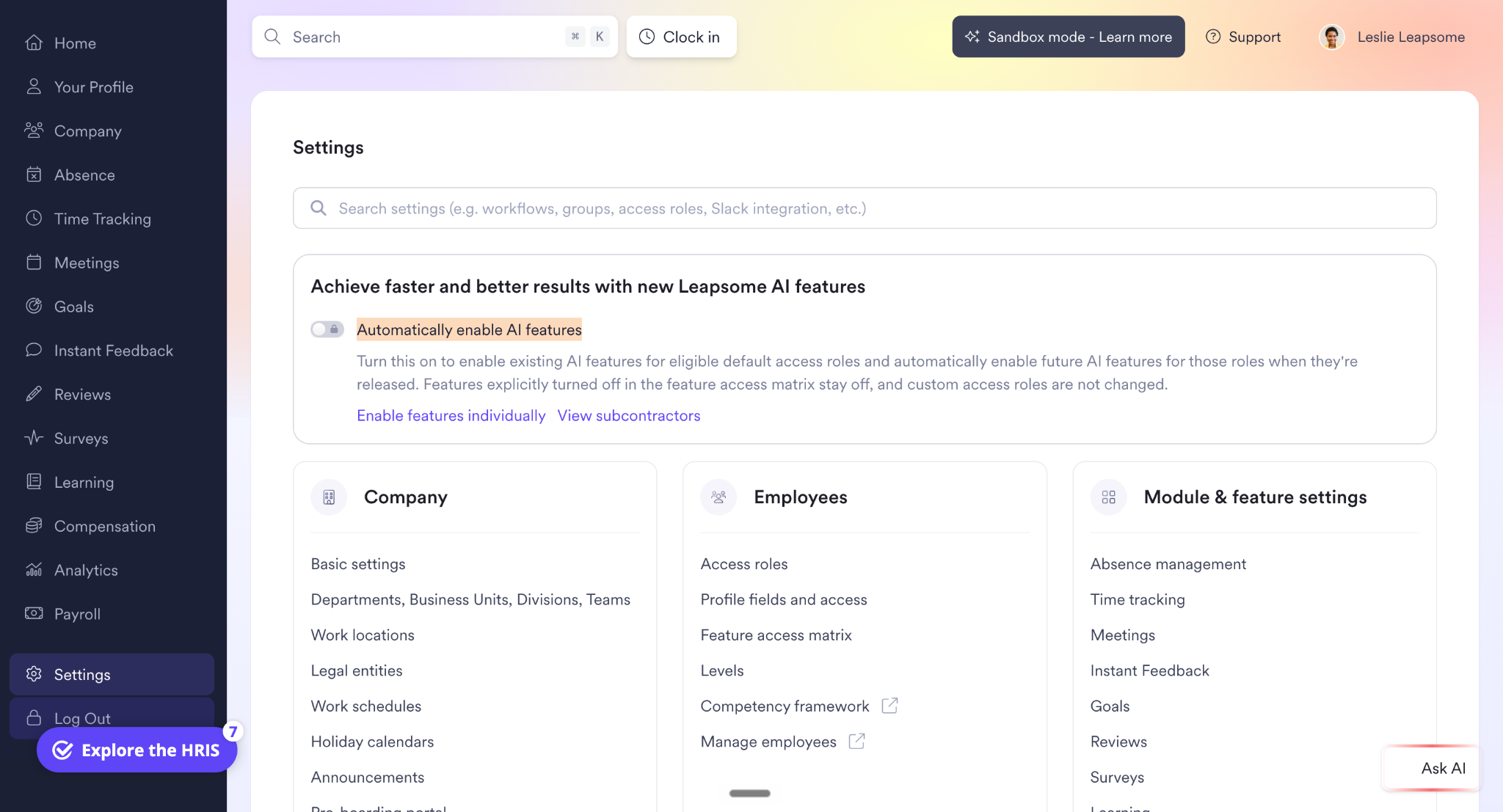
💬 Feedback that never loses the plot
Give managers a streamlined way to share employee feedback and recognize good work in the moment, coupled with dedicated tools for building on that feedback when the next 1:1 rolls around.
👉 Explore Meetings and Continuous Feedback
Prioritize development for productivity gains that last
“Competency frameworks are not just checklists. They’re roadmaps for growth and accountability. They help managers coach more effectively and give employees a clear picture of how to succeed at every level.”
— Monica Sarkar, Co-Founder, Purple Umbrella
Employee development plans are easier to manage and develop when they’re linked directly to goal-setting and performance management practices. This creates a targeted response to real skill gaps. With everything disconnected, training becomes a one-off exercise unlikely to have lasting effects.
Create a system that works in practice, not just on paper
HR managers are usually under serious pressure to get productivity up, and tactics like increasing employee monitoring or encouraging heavier and heavier workloads can seem like quick fixes. In reality, they tend to create the stress and tension that slows work down.
That’s why Leapsome’s HRIS and people management system combines everything organizations need to promote long-term, sustainable productivity in one unified platform:
- Goals: Set and track Goals and OKRs aligned with your organizational goal-setting framework.
- Continuous feedback and coaching: Give Continuous Feedback instantly instead of waiting for the next review cycle. Leverage AI-powered analytics to surface feedback trends.
- Learning and development: Create Learning and Development programs aligned with company goals in minutes. Sign managers up for Leapsome Academy to sharpen their management practices, coaching, and leadership skills.
“Employee engagement, feedback, and good goal-setting processes are the rocks that every company needs as the basis to support their growth.” — Benjamin Böhmer, Director of People & Culture Group, heycar Group
🛠️ Swap tired tactics for prolonged productivity
Tie goals, feedback, and development together to give managers the tools and visibility to bring the best out of their teams.
👉 Request a demo
FAQ
What’s the main cause of low employee productivity?
The main cause of low employee productivity varies by organization, but it often stems from low engagement. Productivity may continue to stagnate or fall when HR teams focus on outdated methods, such as more employee surveillance, stricter attendance policies, or a constantly growing stack of software subscriptions.

.jpg)



.jpg)