
Do part-time employees get benefits? What HR leaders need to know


Disclaimer: This content is for general informational purposes only and does not constitute legal advice. Leapsome does not guarantee legal compliance and cannot confirm how specific situations would be assessed in court. If you're unsure how the requirements apply to your organization, please consult qualified legal counsel.
When you’re scaling your workforce on a tight budget or looking for support during the busy season, hiring part-time employees can be a strategic move. Part-time roles widen your hiring reach and add operational capacity, but they aren’t the same thing as full-time positions with fewer hours.
As you’re planning your growth strategy, ask: Do part-time employees get benefits at your organization, and should they? According to KFF’s research, only 19% of part-time workers have employer-sponsored coverage from their own jobs, compared to 62% of full-time workers.* That gap gives employers room to stand out and strategically use benefits to attract candidates and retain reliable employees.
Eligibility often depends on hours worked, region, and employee classification, so HR teams need centralized people data to track who qualifies for what. That’s why HRIS platforms have become essential for managing part-time benefits with less compliance risk and better workforce visibility.
In this article, we’ll cover what counts as part-time work, the benefits part-time employees can receive (and which are legally required), and how to use those benefits as part of a smarter workforce strategy.
* KFF, 2025
Who counts a part-time employee?
Companies often use part-time roles to add capacity without committing to new full-time roles or reach talent that doesn’t work on a full-time schedule. For HR teams, the challenge is that “part time” doesn’t really have one definition. Classification depends on local laws, benefit plans, and the company’s own policies.
This disconnect in what’s considered part time creates a compliance risk when different teams apply different thresholds. That’s why HR teams need a clear internal definition of part time to decide which employees qualify for certain benefits and when they need to review an employee’s status.
Minimum and maximum hours for a part-time shift
“Creating pay bands means defining minimums, midpoints, and maximums for each role. It’s not just a number, it’s a system that supports fairness, clarity, and long-term growth.”
— Alexandra Edl, Senior HR Consultant, Interim Manager, Coach and Trainer at EDL Consulting
There’s no universal minimum or maximum number of hours that automatically makes an employee part-time. Different agencies and organizations use different benchmarks:
- United States Bureau of Labor Statistics (BLS): The BLS generally classifies employees who work up to 34 hours per week as part-time.
- United States IRS: For Affordable Care Act (ACA) purposes, the IRS considers employees who work less than 30 hours per week, or 130 hours per month, to be part-time.
- EU: Looking beyond the U.S., the EU’s Part-Time Work Directive defines part time very broadly. Part-time employees are people whose working hours are lower than a full-time employee in the same organization or sector.
Because there’s no single legal standard, many employers use 30 hours per week as the practical limit for part-time status and benefits eligibility.
What benefits can part-time employees receive?
In the U.S., it’s usually optional to provide benefits to part-time employees. This lack of firm requirements gives employers flexibility to design a package that fits their strategy and budget, and create a way to stand out for exceptional employee care.
Commonly offered benefits include:
- Health insurance: While employers are not generally required to provide health insurance to part-time employees, some extend coverage to attract talent and improve retention.
- Paid time off (PTO): According to PwC, 59% of employees are stressed about their finances, so employees without PTO often feel like they can’t step away from work when they need a breather. Employers that offer PTO can make part-time roles feel more stable and reduce the chance those employees will suffer from burnout. Typically, this PTO is prorated based on hours worked.
- Fringe benefits: Part-time employees may also receive benefits like employee discounts, wellness programs (especially alongside health insurance), or retirement plan access. These benefits are often less expensive than others, like relocation stipends or matching 401ks, while still improving the overall value of the role.
What benefits are part-time employees legally entitled to?
Some protections apply to part-time employees regardless of their schedule. While requirements vary by state, HR teams commonly need to account for the following:
- Workers’ compensation: In most states, workers’ compensation coverage applies to both part-time and full-time employees. Eligibility is based on employee status rather than weekly hours, so a lighter schedule doesn’t cut coverage obligations.
- Health insurance: The ACA doesn’t require employers to offer health insurance to part-time employees. However, applicable large employers (ALEs) should be aware that employees who average 30 or more hours per week, or 130 hours per month, are considered full-time by the ACA.
- FMLA leave: Part-time employees can qualify for unpaid, job-protected FMLA leave if they work for a covered employer, have worked there for at least 12 months, and have completed at least 1,250 hours in the previous 12 months.
- Retirement plan access: Long-term part-time employees may qualify for a 401(k) under SECURE Act rules. As of 2025, many plans must let employees participate if they’ve logged at least 500 hours of service in two consecutive years.
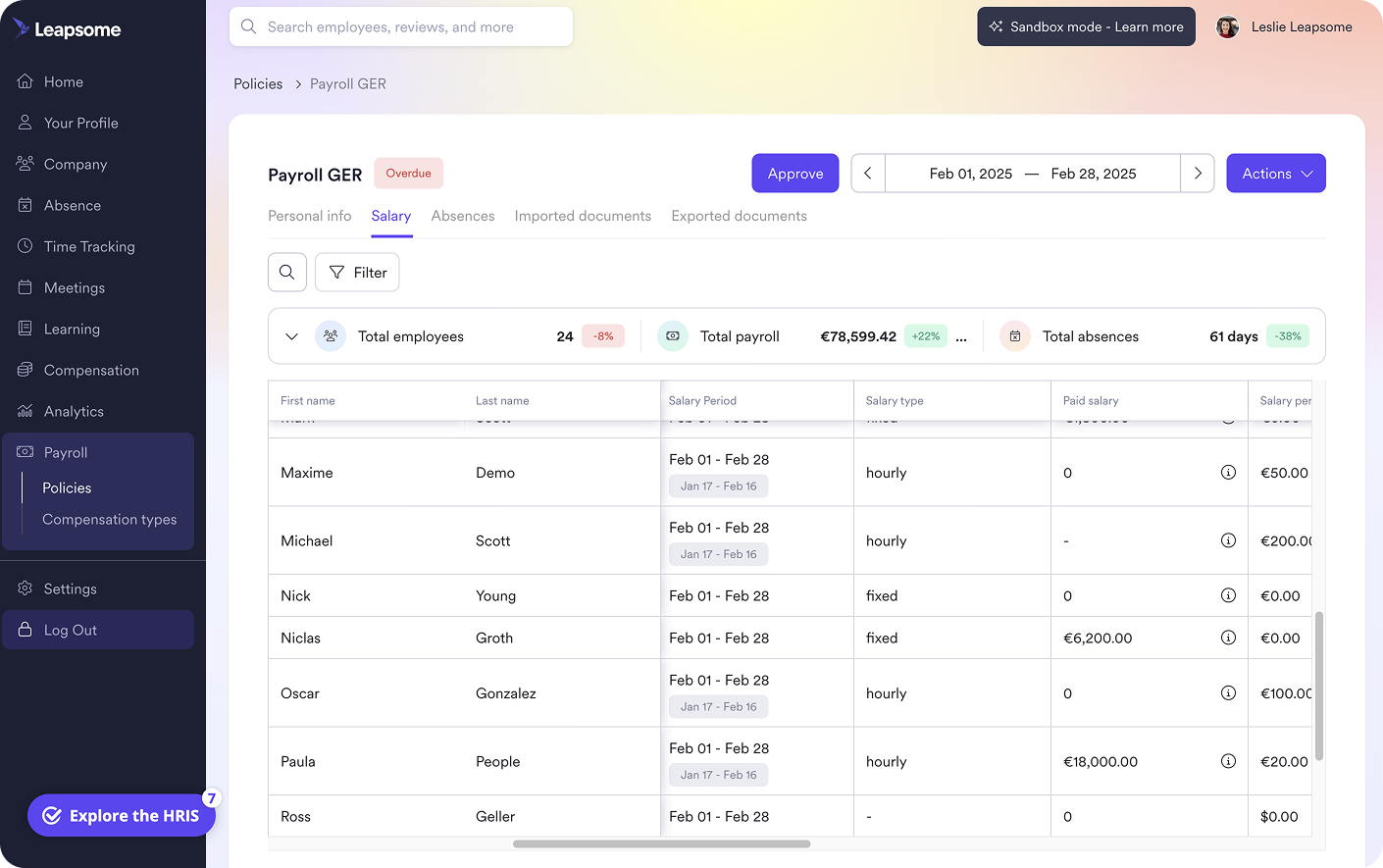
- Overtime pay: Employers must pay nonexempt part-time employees overtime under the FLSA when they work more than 40 hours in a workweek. But depending on your payroll cadence, that overtime can be hard to track. HR teams juggling full and part-time employees need a centralized HRIS and people management system like Leapsome to track hours, calculate overtime accurately, and keep payroll records compliant for everyone.
💰 Simplify and streamline your compensation practices
Leapsome’s Payroll Prep helps HR teams calculate overtime, apply deductions, and keep payroll records compliant without relying on manual calculations.
👉 Explore Payroll Prep
Advantages of offering part-time employee benefits
Part-time employees already create value for the business. They help companies gradually scale the workforce, adapt to changing demand, and access talent that may not have room in their schedules (or interest) in full-time roles.
Benefits can increase that value even further. When you invest in part-time employees, you’ll often see stronger workforce stability and a better return on your hiring efforts.
Here are a few advantages to consider:
- Stronger hiring competitiveness: Many employers offer part-time employees the bare minimum. A part-time job with a stronger benefits package can help you stand out. According to a 2025 Randstad Global Employer study, 72% of applicants notice and value attractive benefits.
- Reduced turnover: Even a modest benefits package can increase retention in part-time roles. Just adding PTO reduces the overall likelihood that an employee will quit by 35%, according to a 2025 study published in the International Journal of Manpower.
- Improved engagement: Benefits make a big difference in employee engagement levels. Benify’s Happiness Index found that employees who were most satisfied with their benefits reported engagement levels 11.5% higher than average, and 25.3% higher than employees who were least satisfied with their benefits.
“Disengaged employees who stay quietly can drain a company faster than those who leave. Engagement isn’t about who stays, it’s about who contributes with energy and ownership.”
— Emma Leeds, Founder, CEO, and Chief People Consultant at People Function
⚖️ Measure the impact of part-time benefits
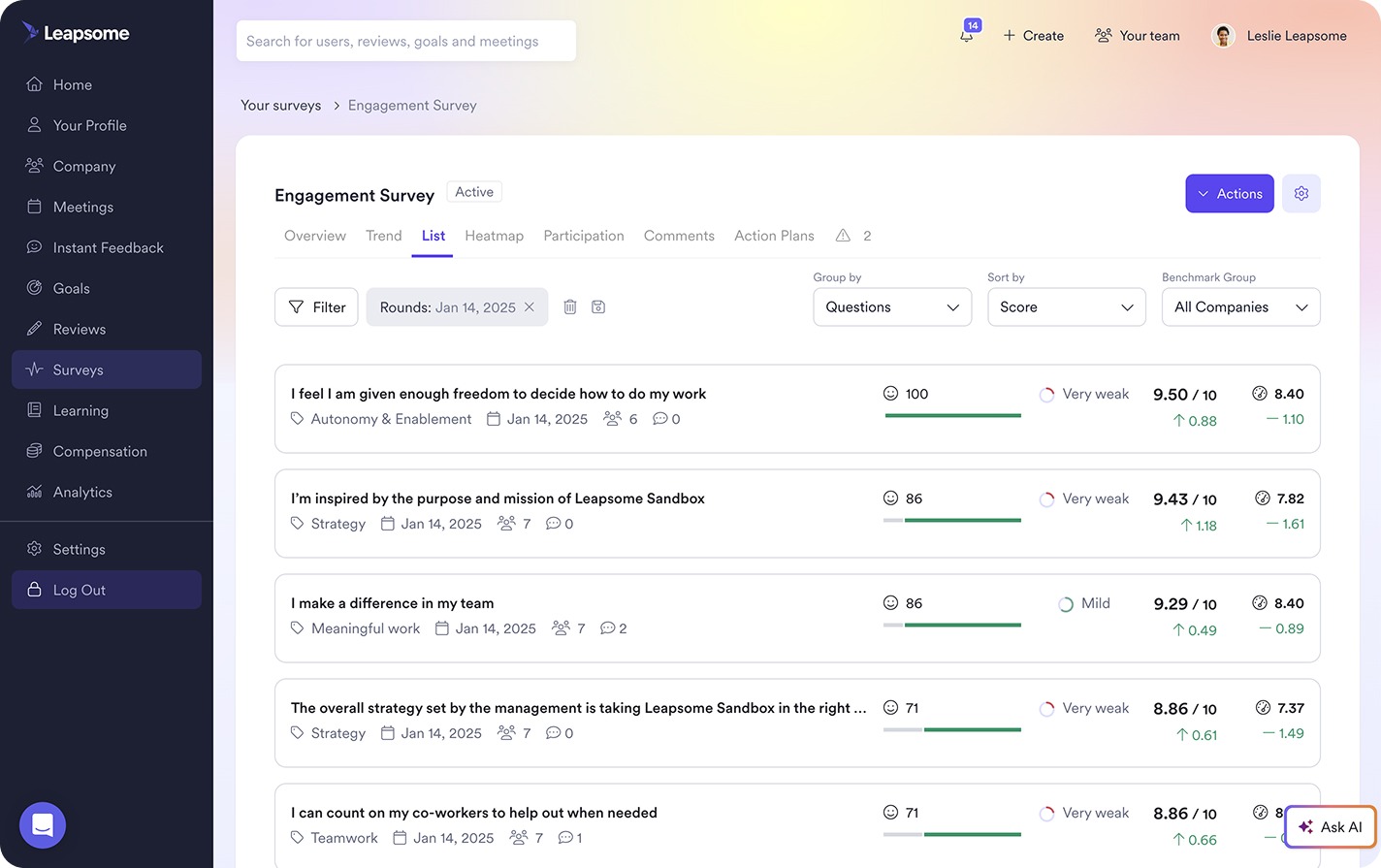
Leapsome’s Engagement Surveys help HR leaders see if added benefits are improving the daily lives of their part-time workforce with sentiment trends across employee groups for faster, more targeted action.
👉 Explore Engagement Surveys
Part-time benefits as a strategy for retention and hiring
Many organizations still treat part-time benefits as a compliance requirement or a cost to control, but this narrow view limits your strategic opportunities.
As of August 2025, more than 28 million employees in the U.S. work part time. Alongside a roughly 4.5% unemployment rate (about 7.5 million people) and findings from PwC that expanded benefits are among the top reasons for considering a move, HR leaders get a clear message: You can use benefits to shape hiring and retention strategies.
Instead of cutting the benefits budget by default, HR should compare two costs: what it takes to offer targeted benefits and what it costs to keep replacing part-time employees. According to SHRM, the intense hiring pipeline means organizations often have to pay three or four times the annual cost of the role itself (much more than a well-designed benefits package).
“Every dollar we spend on employees should be optimally spent — repurpose funds from ‘nice-to-haves’ to what drives the business forward.”
— Melanie Naranjo, Chief People Officer at Ethena
Here are a few signs that it might be time to expand your part-time benefits:
- Repeated turnover in specific part-time roles: If the same positions keep reopening, employees may not see enough reason to stay. It might be time to evaluate benefits alongside other common turnover causes (like pay, scheduling, and management practices).
- Longer time-to-fill for part-time positions: If attracting part-timers is becoming more difficult, a stronger benefits package may help your organization compete for top talent.
- Part-time employees regularly working almost full-time hours: Employees working closer to full-time schedules often expect stability and support similar to their full-time colleagues for their near-equal work. Depending on their total hours, you may also need to run additional eligibility reviews for health and retirement benefits.
Support your part-time workforce with Leapsome
As business scales, your part-time workers’ hours fluctuate, schedules change, and employee classifications can shift entirely. Without a connected system, HR teams at small and mid-sized businesses struggle to manage their benefits, tracking eligibility manually and reviewing compliance risks after the fact.
Leapsome’s all-in-one HRIS and people management platform gives HR leaders the infrastructure to make benefits decisions using reliable workforce data, with:
- Time tracking: Monitor the hours your employees worked and spot if part-time workers are approaching overtime or benefits eligibility thresholds.
- Employee records: Store employment status, compensation, location, and benefits information in one place.
- Payroll prep: Prepare accurate payroll data using up-to-date employee and time-tracking records.
“With Leapsome, we’ve seen some amazing improvements. The initiatives we identified from the survey results decreased our turnover by 12.2%, increased our survey participation rate to 82%, and it made people more productive and excited to come to the office. Listening and transparency is a part of our culture, and Leapsome is a tool that gives our people a voice. The results are visible to the team members, so they can openly discuss with their managers during their retros.” — Natasa Kovacevic, People and Culture Manager at Eurowings Digital
♟️Turn part-time benefits into a strategic advantage
Leapsome centralizes time tracking, employee records, and payroll prep to give HR teams the data necessary to consistently support part-timer’s benefits.
👉 Request a demo
FAQ
Do part-time employees get holiday pay?
In the U.S., federal law doesn’t require that employers provide paid holidays to part-time employees. However, some organizations offer holiday pay based on collective agreements, local regulations, or an active choice to create a more equitable workplace.
Do part-time employees get PTO?
Employers are not generally required to provide PTO to part-time employees, but many offer prorated PTO based on hours worked to improve retention and create a more positive employee experience.




.jpg)
.png)