The talent management lifecycle: Turning steps into a connected system

The talent management lifecycle doesn’t stop when a new hire has completed their onboarding process. This lifecycle is a much broader process that organizations use to attract talent, develop and engage those hires, and keep high performers in the fold. Strong talent management also establishes a reliable path to leadership, helping HR teams identify and build a roster of promising team members to fill high-impact roles from within.
There’s often a disconnect, however, between talent management strategies and how they play out in the workplace. While 59% of HR leaders view talent retention as their number-one priority, 42% of employees who quit report that their workplace could’ve done something to make them stay.(1, 2) The will for better people management is there, but the execution is lacking.
For many organizations, the problem comes from treating talent management as a series of boxes to tick instead of a cohesive and interconnected workforce system. When everything is linked, one stage feeds into the next, creating a positive feedback loop that continuously strengthens each stage of the lifecycle.
This guide explains how to close the gap between talent management strategizing and operational reality. We’ll explore why disconnected systems fall apart and how to build a talent planning framework that works in practice, not just on paper.
What’s the talent management lifecycle?
The talent management lifecycle is the series of stages organizations use to manage employees, from recruiting to offboarding and everything in between. These processes happen at three levels:
- Recruitment and onboarding: A talent management lifecycle starts with the hiring process. With an impactful role and attractive company culture, high-quality candidates are more likely to be drawn in. Onboarding those newly recruited employees sets the tone for everything that comes next, which has a bigger impact than many organizations give it credit for. According to research conducted by the Brandon Hall Group, a well-designed onboarding program can foster up to 80% higher engagement.
- Employee development and engagement: Once the right people are on board, ongoing talent development helps employees keep growing their skills. That means your talent pool is stronger and sticks around longer; LinkedIn’s 2025 Workplace Learning Report found that 84% of employees say learning adds purpose to their jobs, and employees who find that sense of purpose are more likely to be engaged and stay at their organization.
- Offboarding and exit interviews: Exits probably aren’t a cause for celebration, but they’re a valuable resource if you approach employee offboarding as an opportunity to learn. Structured exit interviews give departing employees the space to provide feedback without fear of professional repercussions. In return, HR teams get a chance to audit and improve their talent management process based on candid data that may be hard to come by while employees are still in the building.
Modern talent management solutions tie each of these stages together through shared workflows, workforce analytics, and centralized employee data, so each move strengthens and informs the next one.
“Commit to development versus growth. Creep, not leap. Invest constantly and develop people on their strengths so they can perform better.”
— Steve Browne, Chief People Officer at LaRosa’s
The hidden costs of disconnected talent pipeline management
Many organizations approach talent management with a couple of systems already in place. But backtracking between programs to find the data you need introduces inefficiencies at best, and, at worst, creates an inconsistent employee experience that can send your retention numbers tumbling.
Here are some of the most damaging problems disconnected systems can create:
- Fragmented employee data: When employee information is scattered across multiple tools, executing data-driven strategies successfully becomes much more difficult. HR teams are forced to waste hours manually reconciling metrics that an integrated system connects by default, and there’s a higher likelihood of mistakes or missing info.
- Inconsistent employee development experiences: Without a standardized talent development process, managers are left to their own devices. That means some employees will be satisfied with the development experience, while others with less effective managers receive subpar training. And when development training programs aren’t coupled with performance and engagement data, there’s no reliable way to gauge effectiveness and improve your people processes accordingly.
- Cloudy workforce visibility: When performance data lives in one platform, engagement data in another, and development data in a third, you only get a narrow piece of the full workforce picture. A manager trying to understand why a high performer is disengaging has to piece together data from multiple sources just to start uncovering the details.
Mature organizations connect the talent management lifecycle end to end, so these problems never show up in the first place. Gartner reports that a good employee experience should work as a strategic way to push through to your business goals, not just to increase employee satisfaction. By using an all-in-one HRIS and talent management system like Leapsome, your processes give your employees a strong foundation to work from.
🖼️ Collect data for the bigger picture
Leapsome’s customizable employee profiles help you put all your relevant employee details in one place so you can connect the dots between performance and business goals.
👉 Explore Employee Records
How to put a broken talent management lifecycle back together
“The purpose of an HR function is to create a people strategy that most effectively drives business goals. It starts with the business, then you build your people strategy from there.”
— Melanie Naranjo, Chief People Officer at Ethena
Whether you had a strong talent management lifecycle that’s fallen into disarray or haven’t built your first one yet, here are a few tips to help you design and operationalize a tightly linked system.
Create an employee data throughline across talent stages
Adopting a centralized HRIS gives you a single source of truth for all your critical employee data. This way, you get a view of every part of the employee lifecycle, so skill gaps, engagement scores, and performance trends are always accessible.
Giving HR teams these quantitative tools to anticipate, rather than react to, talent needs also allows for more effective strategic workforce planning. It’s easier to hire strong new talent when you can see what skills your current teams are lacking. Unified HRIS software also supports employee progression tracking, so you can keep an eye on how your learning and development programs are helping current employees grow and pinpoint the programs’ weak spots.
Use workforce analytics for data-driven talent decisions
Taking advantage of workforce analytics can help you make more proactive decisions. Revealing falling engagement and identifying where it’s coming from (like a team struggling under a heavy workload or a particularly ineffective manager) brings you closer to solving the problem. Long term, using that data effectively can powerfully reduce resignations: Gallup found that highly engaged organizations see up to 51% lower turnover.
Workforce analytics also support succession planning by giving you a snapshot of which employees may be developing the skills necessary to become the next generation of leadership.
Align development, engagement, and performance processes
“We segmented our job levels so managers and employees can see exactly what skills they need to move up. Growth isn’t just about giving you a new title or more money — it’s about mastering new competencies that make you more valuable to the business.”
— Janelle Daugherty, Head of People and Culture at Notion Health
Connecting employee development to engagement insights means development decisions are grounded in hard data instead of assumptions. This makes it easier to catch falling engagement early and take action to turn it around with enriching learning opportunities; employees with access to relevant learning and development opportunities are 21% more engaged, according to Culture Amp.
Layering in feedback systems and performance management creates a direct line between team members’ everyday experiences and how you support their growth. Managers can step in early to address skill gaps before they hurt productivity, and development efforts align with what’s actually going on in the workforce.
If you’re looking for a talent management platform that combines HRIS functionality, workforce analytics, and engagement and performance tracking in the same centralized location, you’re in the right place.
“When people know reviews actually lead to growth, they stop dreading them and start investing in them. Linking feedback to concrete outcomes like pay, promotions, and learning plans turns performance conversations into moments of empowerment.”
— Monica Sarkar, Co-Founder at Purple Umbrella
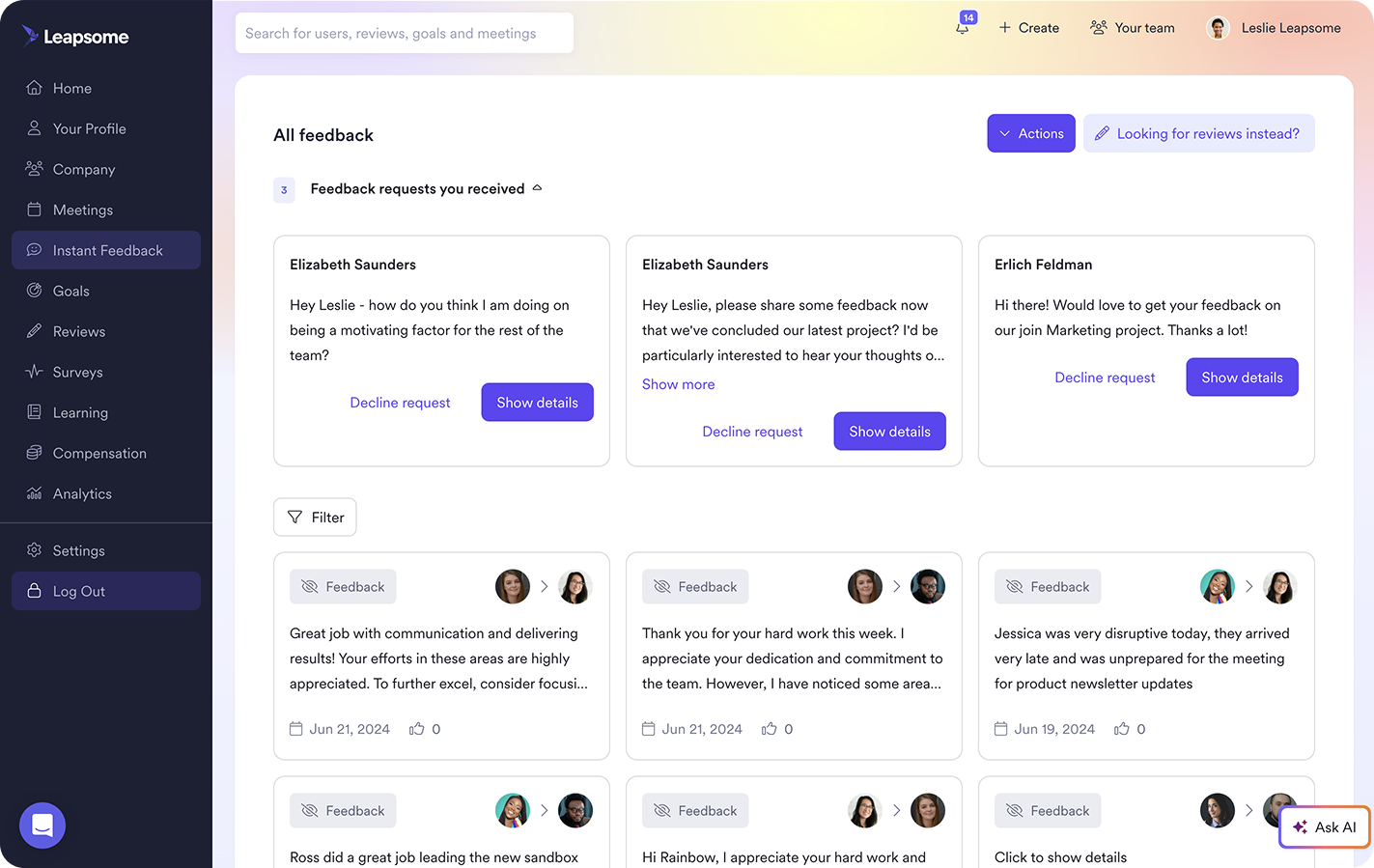
🔗 Situate performance reviews in meaningful context
Leapsome helps you link standardized performance reviews to participation and trend data, so you can identify who’s falling behind and offer learning opportunities to get them back on track.
👉 Explore Performance Reviews
Is your talent lifecycle fragmented or operationalized?
Some talent management strategies look great on paper, but fall apart in practice. These warning signs indicate a fragmented framework:
- Talent data is scattered across disconnected systems: Metrics spread between multiple platforms and tools don’t give HR teams the context they need for strong predictive analytics. If you can easily pull a complete picture of any employee’s performance and engagement history from one place, you’re likely in the clear.
- Employee experiences vary: When the employee’s manager or team determines the quality of onboarding and development experiences, the underlying HR process is poorly standardized. If every employee moves through a largely similar process regardless of their department, you’re on the right track.
- Managers lack visibility into employee growth: How long — and how much effort — does it take for people managers to understand an employee’s growth trajectory? If the answers are “a long time” and “too much,” your talent data probably isn’t as connected as it should be.
The benefits of a connected and operationalized talent management lifecycle are obvious. But to turn these ideas into practice, you’ll need to use a talent management system that connects all your employee workflows. Leapsome combines classic HRIS features and modern talent management for a robust platform HR teams of all sizes can use.
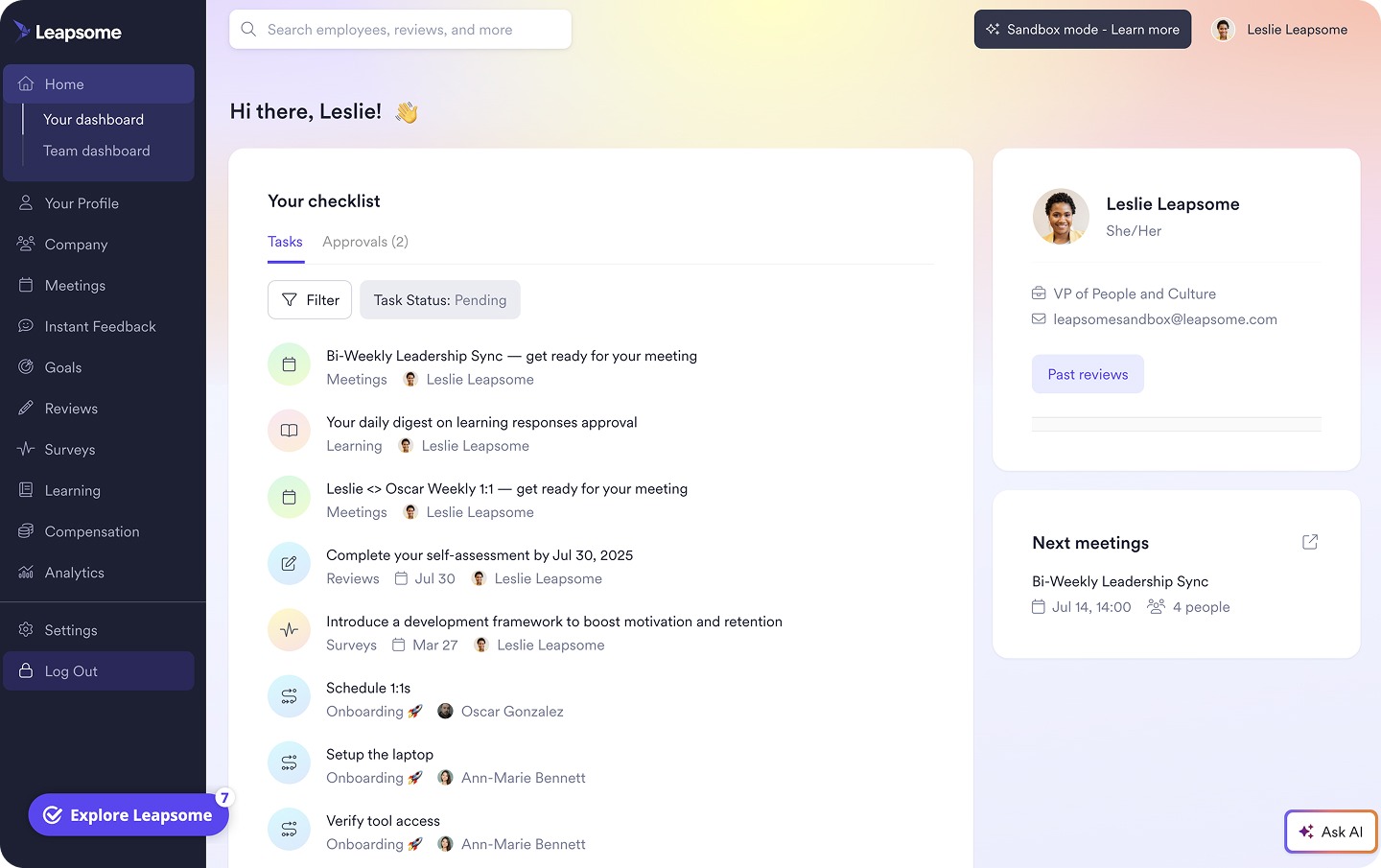
📊 Stop spreading your data thin
Leapsome’s HRIS features connect onboarding and development workflows with performance and engagement data, so even a single piece of information can reveal meaningful insights in context.
👉 Explore HRIS tools
Translate your strategy into reality with Leapsome
Too many organizations struggle with disjointed talent systems, fragmented employee data, and siloed workforce processes that make it virtually impossible to consistently operationalize your strategy. Leapsome is here to change that by:
- Improving workforce visibility: Real-time data across the full employee lifecycle supports smarter workforce and succession planning.
- Centralizing employee lifecycle steps and workforce analytics: Employee details and workforce insights exist in the same place for more contextual decision-making.
- Connecting onboarding, development, and performance workflows: Insights gained during onboarding inform development plans, and discoveries from performance reviews circle back to continuously strengthen both onboarding and development programs.
“One of the biggest impacts Leapsome has had for us is creating transparency around goals. Staff are very clear on what’s expected of them.” — Amita Rao, Director of Talent Management at Orbis
🔄 Trade fragmented chaos for centralized simplicity
Leapsome connects every stage of the talent management lifecycle, from onboarding to exit, so your strategy works as well in practice as it does in theory.
👉 Request a demo
FAQ
What’s talent management software?
Talent management software connects each component of the talent management lifecycle in one convenient location. The biggest benefits of using talent management software include:
- Having a single source of truth for workforce data
- Better workforce visibility, supporting easier career pathing
- Consistent employee experiences
- Smarter, data-backed talent decisions
- Stronger retention numbers

.jpg)