
How shift differentials turn unpopular timeslots into win-win scenarios


It can feel like pulling teeth to get employees to cover graveyard hours, holidays, and other undesirable shifts. If you’re not lucky enough to attract plenty of antisocial night owls, you can encourage the coverage you need with shift differentials.
Shift differential pay compensates team members with higher rates for working hours (and days) outside the norm. A more competitive hourly wage can incentivize people to volunteer and make the effort feel worth their time. While it’s not required by law, many companies find that implementing shift differentials is critical for effective workforce planning and employee retention.
In this article, we’ll explain the most common types of shift differentials and show you how to calculate accurate pay rates. We’ll also talk about whether this is the right move for your organization, and cover some best practices for creating an airtight shift differential policy.
What’s a shift differential, and what problems does it solve?
Not every business has the luxury of a neat and tidy 9-to-5. For example, 30% of full-time employees report working 5–6 hours on an average weekend day.
When your company needs employees to work night shifts, holiday hours, and other less popular schedules, you‘ll have to incentivize them to get onboard. One of the simplest but best ways to do that is by paying a shift differential, which means offering compensation over and above base pay.
It’s an extra cost, but many businesses find this policy essential for maintaining adequate coverage while boosting employee satisfaction. In fact, 92% of companies with hourly employees offer shift differentials.
“HR shouldn’t just support business decisions — you’re shaping them. You have to think like a profit center, not an administrative silo.”
– Anita Anthonj, Founder and CEO at Talaera
The most common shift differentials at a glance
You can offer a shift differential for any non-standard schedule, but these are the most likely scenarios:
- Night differential pay: Typically applies to hours worked between 10 p.m. and 6 a.m., and often referred to as a night shift, graveyard shift, or third shift
- Weekend differential pay: Covers hours worked on Saturdays and Sundays, if that’s not part of regular employee schedules
- Holiday differential pay: Compensates employees for taking shifts on national holidays
- Split shift differential pay: Incentivizes employees to take multiple shifts on the same workday, with a significant gap in between (i.e., 8 a.m. to 12 p.m. and 5 p.m. to 10 p.m.)
How to calculate shift differential pay and avoid costly mistakes
Compared to a lot of the numbers you deal with as an HR leader, calculating shift differential pay is a pretty clear-cut process. First, you’ll need to gather the key figures:
- Hours worked
- Base pay
- Shift differential rate
The shift differential rate is completely up to you — it may be a flat bonus per hour worked ($2 per hour on top of base pay) or a multiplier (e.g., time and a half). Opt for a rate that reflects the value of the work and is enough to get team members interested.
Now to do the math. A flat rate increase is as simple as it gets: To figure out the total pay per hour, you’ll just add the premium to the employee’s base pay.
Say you’re short-staffed during a busy weekend and need a few employees to pick up an extra shift. You might incentivize coverage by offering an additional $2 per hour, so anyone who normally makes $25 per hour will get $27 instead for their efforts.
Now, let’s say you’ve decided to offer a 10% shift differential premium instead of a static increase. In that case, you’ll use the following formula:
(base pay rate × shift differential rate) + base pay rate = shift differential pay
Going back to our example above, the numbers come out to:
($25 per hour × 0.10) + $25 = $27.50 per hour
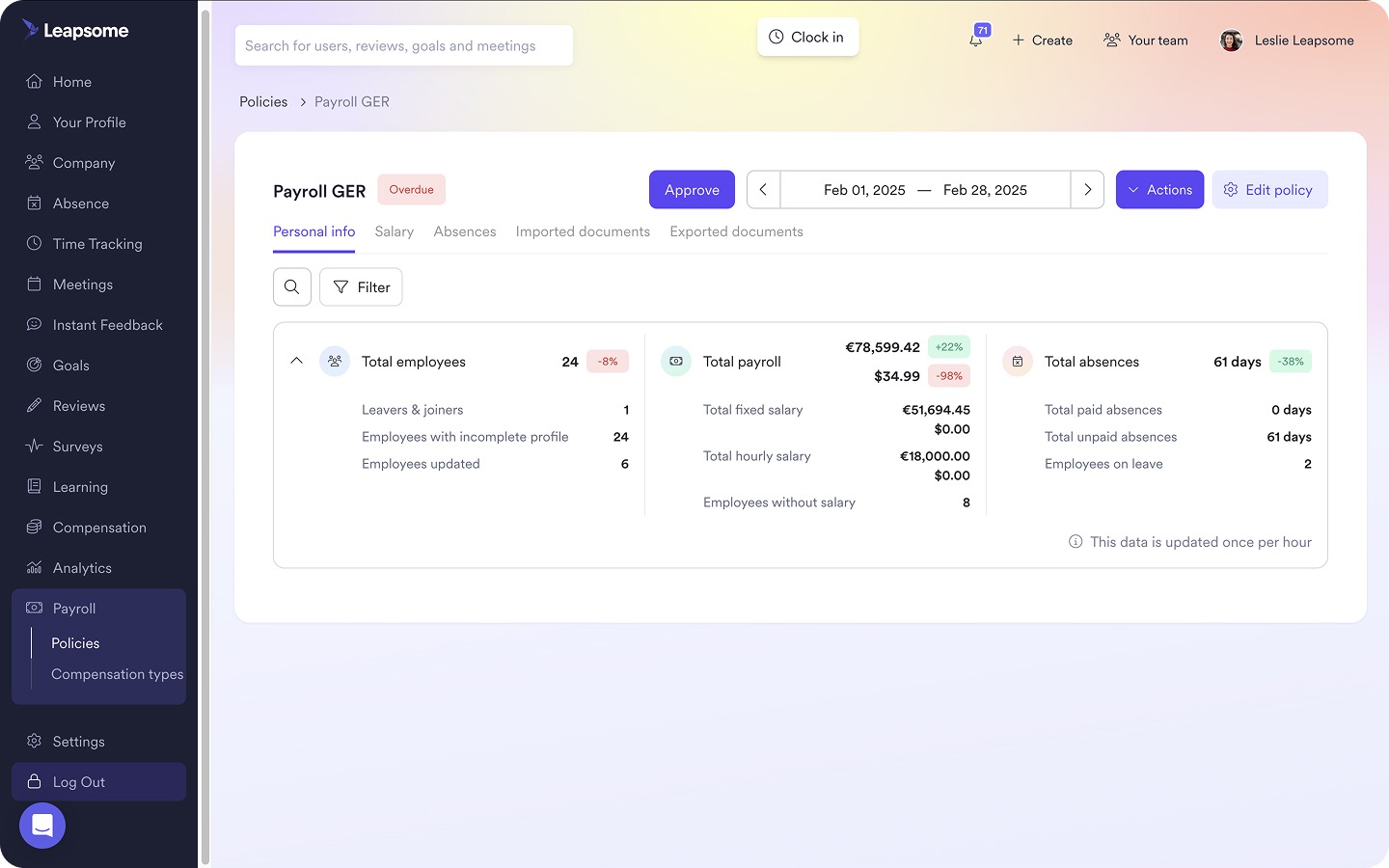
✅ Never cut the wrong paycheck again
Leapsome’s Payroll Prep helps you avoid expensive mistakes by centralizing every pay input and handling complex calculations.
👉 Learn more about Leapsome’s Payroll Prep
Factoring in overtime pay to avoid compliance risks and disgruntled employees
As simple as the shift differential formula is, overtime pay complicates that calculation, because the shift differential alters the employee’s base pay for part of the work week. If you forget to account for this, you’ll wind up dealing with underpayments, inaccurate budgeting, and possibly even labor disputes.
Let’s go back to the scenario from the previous section. Suppose our hard-working employee — we’ll call her Anika — put in 50 hours last week, broken down into 45 day shift hours and 5 night differential hours. Then we’ll throw into the mix a standard overtime pay rate: time and a half for everything over 40 hours.
To pay Anika what she deserves, you’ll calculate a weighted average of all hours worked across both shifts, then add in the overtime. Just follow these steps in order:
- day shift rate × hours worked = total straight time pay
- $25 per hour × 45 hours = $1,125
- night shift rate × hours worked = total night shift pay
- $27.50 per hour × 5 hours = $137.50
- (total straight time pay + total night shift pay) / total hours = weighted hourly rate
- ($1,125 + $137.50) ÷ 50 hours = $25.25
- weighted hourly rate x overtime rate = overtime premium
- $25.25 per hour × 0.50 = $12.625 per hour
- overtime premium × overtime hours = total overtime pay
- $12.625 per hour × 10 hours = $126.25
With all that done, we can finally sort out the employee’s total paycheck for the week:
total straight time pay + total night shift pay + total overtime pay = total compensation
$1,125 + $137.50 + $126.25 = $1,388.75
How to design a policy that keeps shifts covered and employees happy
Shift differentials aren’t something you can just play by ear, or you’ll end up in trouble with both legal and disgruntled employees. A clear policy sets expectations and paves the way for fair treatment, so here are some best practices for getting that done:
- Clearly define eligibility: Outline exactly which roles and shifts qualify for premiums.
- Lay out consistent rules: Keep managers in sync by explaining how they should award shift differential pay consistently and without bias.
- Decide on a differential structure: Tacking on a flat-rate premium is easy to calculate and intuitive for employees. Using a percentage-based increase is a little trickier, but it scales nicely with different compensation levels.
- Regularly review pay rates: Periodically compare your shift differentials against market research and your employee retention rate, and update your policy as needed to keep it competitive and fair.
- Communicate how shift differentials work: Thoroughly explain the plan to managers and employees alike. Share how you’ll calculate shift differentials and how this policy will affect overtime pay.
“Money is a sensitive topic, so communication is everything. Use clear, simple language, and make sure leaders know how to talk about pay with confidence and care.”
– Alexandra Edl, Senior HR Consultant at EDL Consulting
So, should you use shift differentials?
Not every policy is a necessity for every HR department. To decide if shift differentials are worth the effort, consider these advantages:
- Better coverage for hard-to-fill schedules: Shift differentials help with workforce planning by incentivizing employees to take the shifts people complain about — and maybe inspiring them to complain a bit less.
- Happier employees, happier bosses: Employees who feel fairly compensated tend to be more engaged and productive, and they’re more likely to stick around. About 63% of companies find that their compensation decisions drive positive results. And as confidence in pay decisions increases, employee sentiment rises, and both time-to-fill and voluntary exits decline.
- A competitive edge: A well-run shift differential program supports key engagement metrics, like your employee net promoter score, so it’s a great way to attract and keep top talent.
“HR leaders should create competitive and equitable compensation packages by setting ranges based on market pricing and regularly benchmarking salaries to stay aligned with market trends.”
– Tracy Cote, Chief People Officer at Slickdeals, for Forbes
Or is all of this a waste of time for your company?
The pros might sound compelling, but we’d be remiss not to mention the drawbacks, too:
- Higher cash outlay: Shift differential pay costs more — it’s obvious, but it has to be said. It’ll affect your budget. Still, adequate staffing and improved employee morale can more than make up for that added cost.
- More complicated payroll: When you have to account for differing pay structures and more complex overtime pay calculations, payroll is harder to get right.
- Less predictable budgeting: When shifts and pay rates fluctuate throughout the week and year, it’s a bit more challenging to create accurate budget forecasts.
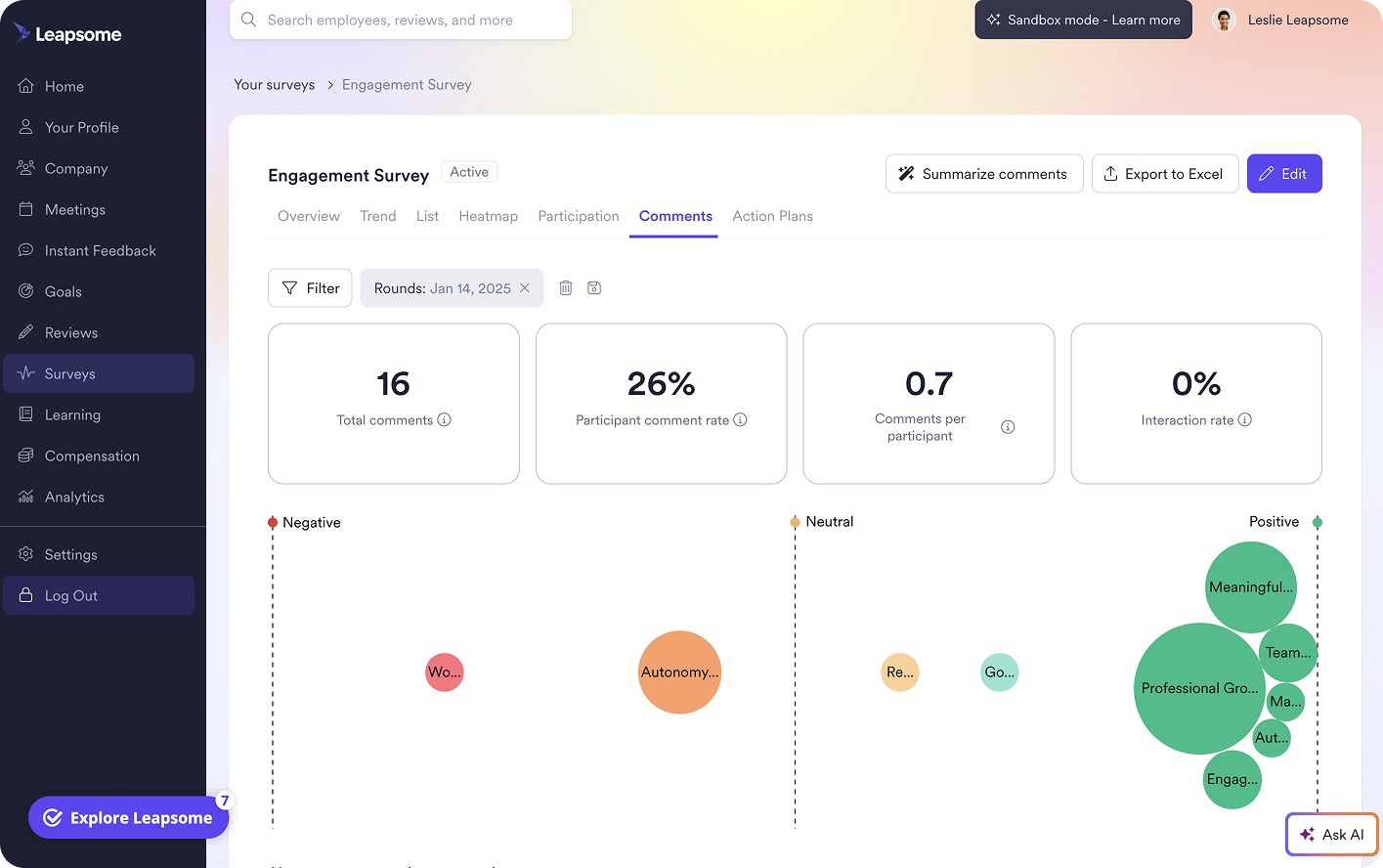
❓Find out what employees actually think about your HR policies
Leapsome’s Engagement Surveys show how your employee incentivization efforts perform, and let you monitor retention and perception so you can tailor your strategies.
👉 Learn more about Leapsome’s Engagement Surveys
Spend less time managing spreadsheets and more time keeping great employees with Leapsome
Calculating shift differential pay can be a real pain, especially if you rely on manual methods or outdated software. Leapsome gives you the unified employee data, pay equity monitoring, and centralized documentation you need to handle every aspect of compensation thoughtfully and accurately.
Leapsome is more than a sophisticated calculator — it’s the strategic command center that underpins your entire payroll system and keeps HR running smoothly.
“The amount of time we save as an organization by using Leapsome versus our old methods is probably worth more than the cost of the module.” – Marc-André Lacombe, VP of Engineering at MavTek
👀 Understand your pay equity situation at a glance
Leapsome’s Compensation module gives you a clear picture of your compensation profile without overly complex data analytics.
👉 Request a demo
FAQ
How does a shift differential work?
A differential payment is a premium companies pay on top of an employee’s base pay. This incentivizes working at undesirable times, such as evening, weekend, and holiday shifts. Most shift differentials are based on a flat rate or a percentage of employee base pay.
Is there a calculator for determining shift differential pay?
You can find simple shift differential calculators online, but Leapsome offers a more robust (and still easy to use) solution. Our platform lets you go beyond simple number crunching by combining comprehensive compensation data, pay equity monitoring, and employee sentiment data in a centralized dashboard.