What do payroll services cost?: A guide to smoother payments


Managing payroll relies on accurate calculations, yet math skills are rarely the deciding factor in the quality of your payroll cycles. Small teams often struggle with fragmented systems that force them into expensive manual data reconciliations. According to a survey run by Paychex, HR teams spend over five hours every month just navigating wage compliance and documentation.* These disconnected processes increase compliance risks and drain your limited resources.
To make payroll easier, many companies turn to outside vendors and payroll software. Those services rarely list exact costs, and when they come with paid add-ons you thought would be included and steep fees for every new hire, it can feel almost impossible to judge if a payroll service’s cost fits your business size and needs.
That’s why we created a guide that provides you with transparent pricing to determine the real cost of payroll services for small businesses. In this article, we’ll give you expert advice to help you avoid overpaying for complexity you won’t use.
* Paychex, 2026
How much does payroll cost? A breakdown
The average payroll software cost fluctuates depending on the provider and the depth of service you need. Some vendors offer low-cost or free tiers with limited support, which can work for small, single-location organizations that don’t offer complex benefits. However, most growing companies go for solutions with a base monthly fee and a per-person charge.
The following table compares six popular payroll vendors to help you get a sense of realistic pricing and core functionalities.
Factors that affect payroll pricing
“Too often, managers say, ‘because HR said so.’ That’s not enough. They need to be trained to explain pay decisions with empathy and transparency.”
— Alexandra Edl, Senior HR Consultant, Interim Manager, Coach & Trainer, at EDL Consulting
Budgeting for payroll requires looking beyond the sticker price. There are several operational variables that might change your monthly metrics.
How many employees do you have?
While base payroll services fees usually remain flat, your total cost scales with your headcount and add-ons. For example:
- 50 employees: You might pay between $350 and $600 per month.
- 100 employees: Costs typically rise between $700 and $1,200.
- 200 employees: Expect to spend $1,400 to $2,400 monthly.
- 500 employees: Larger teams often see costs between $3,500 and $6,000.
How often do you pay them?
The frequency of your payroll runs will affect your average payroll cost per month because many vendors charge per pay cycle. So, processing weekly payroll costs an organization significantly more than a bi-weekly or a monthly pay period will.
Where are they located?
Extra fees come into play when you’re managing a distributed team across different states or countries. Hiring international employees means more complex tax compliance navigation, and payroll service providers usually charge more to handle specific tax registrations and local filings for each new jurisdiction.
Are they contractors or true employees?
Payroll vendors usually charge lower fees for contractors (who receive IRS Form 1099-MISC), because they don’t have to calculate tax withholdings or manage company-sponsored benefits for these individuals. While this reduces your monthly software spend, a W-2 employee and independent contractor have very different legal classifications and work requirements, so your team will need to monitor and manage these roles precisely.
Who handles the data administration?
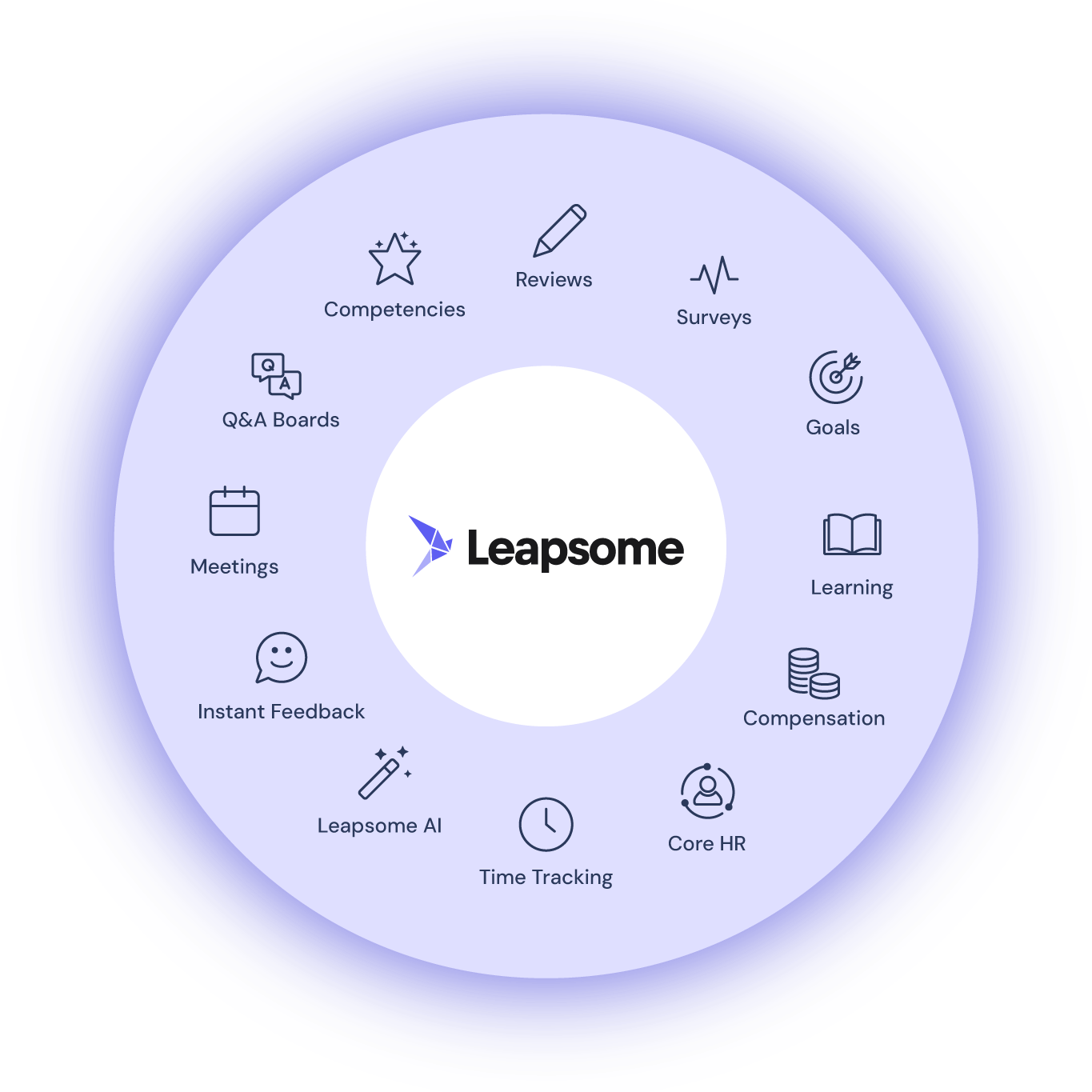
Full-service plans manage tax filing and compliance (at a premium price), but you still need to provide accurate data for those plans to work. Integrating your payroll service with an HRIS platform like Leapsome means you can automatically sync your employee records and payroll software. You’ll only pay for the third-party services you actually need, while eliminating the hidden costs of fragmented data.
🔗 Connect people data with your payroll provider
Leapsome’s HRIS Integrations automate the flow of information between your employee data and your chosen payroll service provider to reduce manual effort and support compliance.
👉 Explore Integrations
In-house vs. outsourcing vs. PEO: How to choose
"Switching tools has a big cost. Always plan for scalability and test integrations early — what works globally must still fit locally."
— Marie Richter, Fractional VP People & Consultant
Outsourcing your payroll to an expensive enterprise solution isn’t usually the most responsible choice for a small business. To reduce admin time and improve accuracy in your payroll process, choose a model that fits your organization’s scale. That means deciding between a professional employer organization (PEO), a payroll service, and bolstering your in-house efforts to keep your budget predictable.
In-house payroll
When you keep payroll fully in-house, your internal HR and finance teams manage every aspect of the payroll cycle:
- How it works: Staff handles data entry, payroll tax filings, and manual compliance checks internally.
- Typical cost: You pay a payroll specialist’s salary, averaging between $50,000 and $90,000 annually.
- Best fit: Large companies with high payroll processing control requirements and complex internal structures.
- Hidden trade-offs: This model places a heavy administrative burden on your existing staff.
- Risk: Manual data reconciliation increases the likelihood of human error. According to research from the National Association of Women Business Owners, the average payroll error rate is 1.2% per pay period, and 50% of employees will look for a new opportunity after just two payroll mistakes.
Payroll software
When you use payroll software, an automated platform like Gusto or ADP processes payments while control stays in-house:
- How it works: The software automates calculations and tax filings based on your manual data inputs (unless you automate this step via a different tool), then sends pay to your employees.
- Typical cost: Monthly base fees range from $20 to $100 plus a per-employee fee between $5 and $15. Many have paid add-ons for programs like workers’ comp.
- Best fit: Small teams with fewer than 100 employees and simple payroll structures.
- Hidden trade-offs: Your team remains responsible for the accuracy of every data point, so admin time stays relatively high.
- Risk: Fragmented tools still require manual updates and time-consuming reconciliation across different systems. Pair your software with a centralized HRIS to keep your payroll inputs accurate with less effort.
Payroll outsourcing
According to ADP’s global payroll survey, 70% of leaders are considering outsourcing some of their payroll processes. Here’s what it looks like when a dedicated payroll provider takes over your payroll and reporting operations:
- How it works: Your team steps back and the vendor manages compliance, tax filings, and direct deposits for your organization.
- Typical cost: Monthly fees range from $15 to $40 per employee, plus service fees for complex reporting.
- Best fit: Growing companies that manage international employees or lack internal payroll tax expertise.
- Hidden trade-offs: You’ll lose control over and visibility into the payroll process, so correcting discrepancies takes longer.
- Risk: You’re fully reliant on an external team for all record updates.
PEOs
The PEO co-employment model allows the provider to manage payroll, benefits, and compliance under their own tax ID:
- How it works: You share employer responsibilities with the PEO to get access to better benefits and compliance support. They take over admin tasks, including payroll.
- Typical cost: You pay 2% to 10% of your total payroll, or flat fees between $100 and $200 per employee, typically monthly.
- Best fit: Companies that need enterprise-level benefits to attract talent across regions with stronger benefit packages than they qualify for alone.
- Hidden trade-offs: Your HR costs will grow at the same rate as your company — or faster. You’re on the hook for mistakes the PEO makes and other liabilities.
- Risk: Co-employment makes it less clear who employees actually work for, and you lose insight into admin processes.
“Money is a sensitive topic, so communication is everything. Use clear, simple language and make sure leaders know how to talk about pay with confidence and care.”
— Alexandra Edl, Senior HR Consultant, Interim Manager, Coach & Trainer, at EDL Consulting
Payroll and HRIS: Why costs don’t tell the full story
The real financial challenge of a growing organization’s payroll process isn’t new monthly vendor fees, but the hidden cost of payroll awkwardly existing out of context in your HR ecosystem. Payroll can’t stand alone. It requires accurate inputs like employee compensation records, time and attendance, and compliance workflows to function correctly.
When your tools are disconnected, the hours your team wastes fixing typos or hunting for spreadsheets add up. This invisible operational debt comes from:
- Manual data reconciliation: HR teams spend hours moving numbers between spreadsheets and software.
- Increased error rates: Tiny mistakes in fragmented systems accumulate damage to data accuracy and employee trust.
- Off-cycle payroll runs: Fixing mistakes requires payments outside the regular pay cycles and expensive processing fees for the addition.
- Compliance exposure: Disconnected systems make it difficult to pull accurate reports for labor audits.
Your payroll provider is much more prone to making manual errors in a disconnected system. But if you also integrate an HRIS, you can be sure that every salary update and spent PTO flows into your payroll software without needing human intervention.
✅ Ensure every payout is accurate and compliant
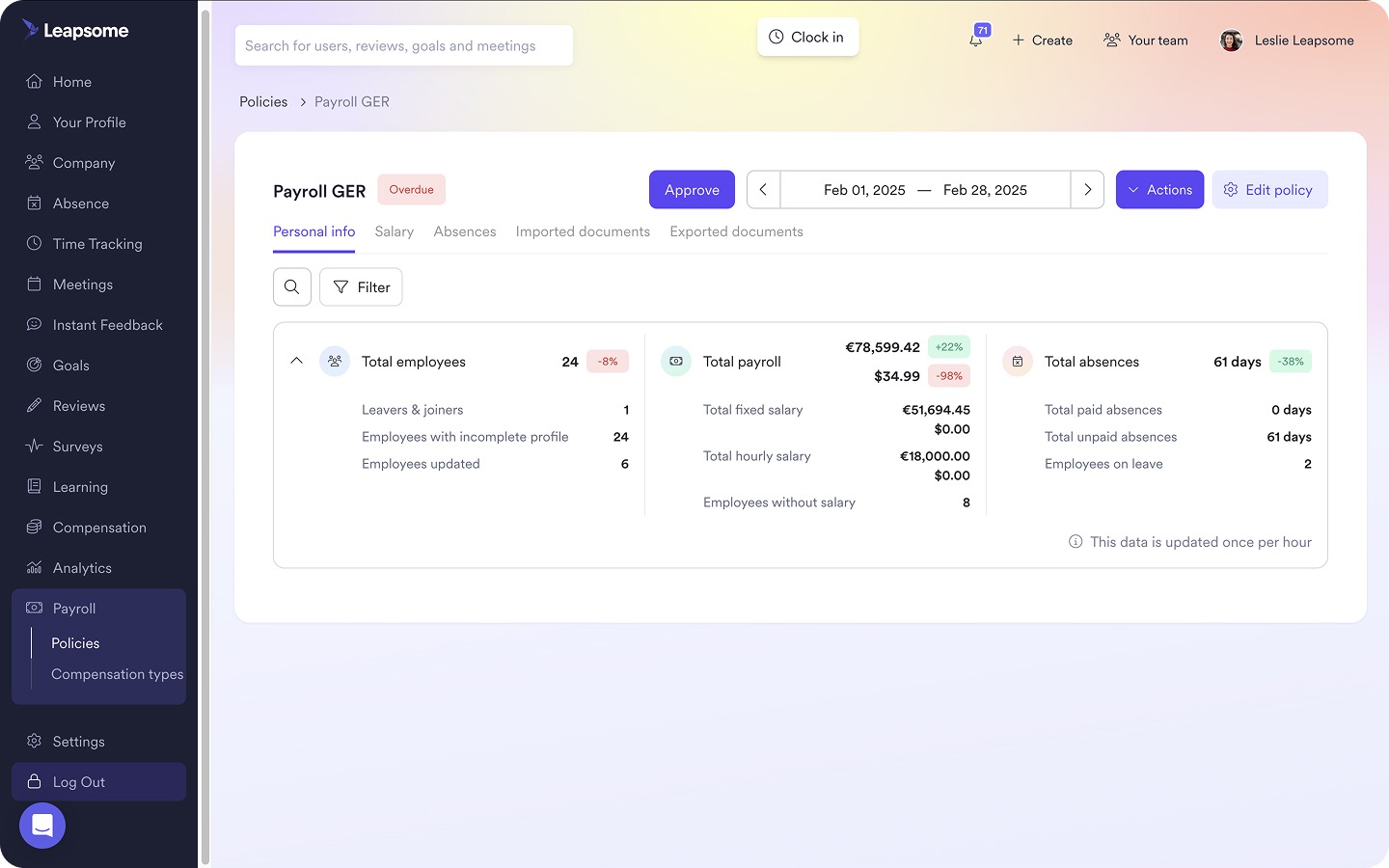
Leapsome’s automated Payroll Prep syncs updates to employee data, compensation changes, and absences to ensure payroll accuracy and compliance.
👉 Explore Payroll Prep
Streamline payroll and HR operations with Leapsome
HR leaders often struggle with limited resources when the company scales and payroll complexity surges. Managing employee records and compensation updates across disconnected systems creates a cycle of constant inefficiency: You lose hours to manual reconciliation and open yourself up to avoidable compliance risks.
Your payroll process feels like a burden because your surrounding workflows lack a single source of truth.
Leapsome’s Payroll Prep feature provides a reliable framework to eliminate this operational debt. Enjoy an automated process that keeps payouts correct and compliant, with accurate employee data from our complete HRIS flowing seamlessly into your payroll workflow.
“With Leapsome, we were able to automate performance reviews, goal setting that was even prior, but now even further and onboarding and offboarding and that together helped us save about 20% of manual effort of our team.” — Weronika Czerny-Nowakowska, Chief Operating Officer at Neurons Lab
💸 Save more than just the vendor fee
Leapsome’s people management platform eliminates the hidden costs of manual payroll and messy workflows with an all-in-one system, so you have the resources to keep your HR operations people-focused.
👉 Request a demo




.jpg)